
Poetry’s capacity for experimentation makes it incredibly useful for exploring dreams. A poem’s logic is a dream’s logic: associative images cohering into something meaningful, if vague or unsettled. Here’s a prompt for writing poems about dreams.
Freewrite
Think of a dream that you had. It can be a recent dream or one that was memorable.
Freewrite, with a very close attention to detail, what happens in the dream. Don’t worry about making linear sense: capture the feeling of the dream, its transitions and connections and disjointedness. What sequence of images occurred? What is the mood of the dream? Who’s in it? What do you recognize? What’s unfamiliar? Who are you in the dream? What does the dream want to tell you about life?
Depending on your mind and the quality of your sleep, this may be a difficult exercise. Keeping a dream journal usually helps you remember your dreams over time. However, if you’re someone who rarely has access to their own dreams, perhaps the following poems about dreams will help spark some inspiration.
Dream Poem: “Goat” by Jasmine Ledesma
Retrieved from her Tumblr, reproduced both in text and image below:
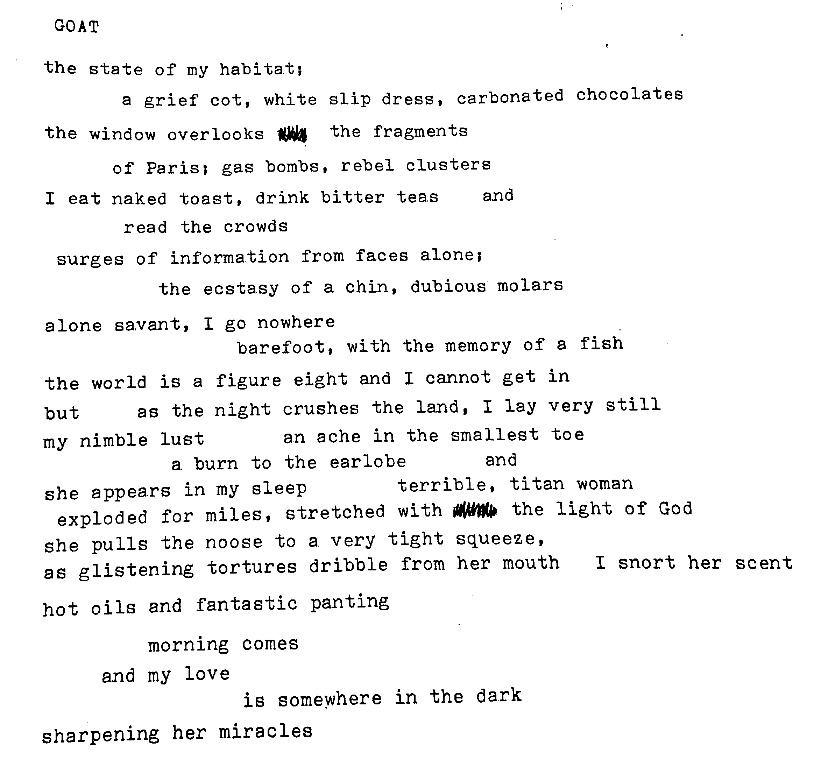
GOAT
the state of my habitats
a grief cot, white slip dress, carbonated chocolates
the window overlooks the fragmentsof Paris; gas bombs, rebel clusters
I eat naked toast, drink bitter teas andread the crowds
surges of information from faces alonethe ecstasy of a chin, dubious molars
alone savant, I go nowhere
barefoot, with the memory of a fish
the world is a figure eight and I cannot get in
but as the night crushes the land, I lay very still
my nimble lust an ache in the smallest toea burn to the earlobe and
she appears in my sleep terrible, titan woman
exploded for miles, stretched with the light of God
she pulls the noose to a very tight squeeze,
as glistening tortures dribble from her mouth I snort her scenthot oils and fantastic panting
morning comes
and my love
is somewhere in the dark
sharpening her miracles
Divinations
Now this is what a dream feels like! Associative, imagistic, disjointed, and sometimes vaguely spiritual? Brief but intense; unreal, yet believable. I love this poem.
Ledesma is a wizard at persona poetry. In this one, a monk is having a sex dream. And you can feel in the poem’s images the sense of mystical delight and mystical shame occupying the same lines and images. For example:
- A grief cot
- A brief, incredible depiction of the setting of the monk’s ambivalence.
- the fragments / of Paris; gas bombs, rebel clusters
- Perhaps this is a French monk, or perhaps this is happening near or after World War II. Nonetheless, Paris is the city of love, so its fragmentation feels relevant, especially given the poem’s formal gaps.
- the ecstasy of a chin
- Only a man who’s been celibate for a while would get hot and bothered by a mandible.
- terrible, titan woman / stretched with the light of God
- How grotesque, how divine!
I mean, these images aren’t easily erotic, but they are a profound mingling of the sacred and profane.
We also get this movement, which describes, I think, both dreams and waking life:
I go nowhere
barefoot, with the memory of a fish
the world is a figure eight and I cannot get in
As I read and reread this poem, I’m filled with the same feeling I get from my own dreams: that some deeper meaning, if not Absolute Truth, is somewhere almost within reach. Just past the lacunae, just around the aporia. The poem evokes this not only because of its imagery, and not only because of how it juxtaposes different categories of image, but because, right at the moment of insight, we reach something abstract and ineffable: “the light of God”; “glistening tortures”. Sharpened miracles.
Yes, what do we make of those last lines? Shakespeare has the answer: “these violent delights have violent ends.”
But also, pay attention to the mastery of page space. The lines thin and whiten, gap wide with morning’s light: the speaker is waking up, and so the dream text weakens, yet ends somewhere epiphanic. I mean, the monk, in all his regret, believes his love is still out there in the night, and he describes their encounter as a miracle—despite, most likely, his religious convictions.
This is exactly what I want in a dream poem: the sense of dreams, their power and chaos, their proximity to meaning—and an ending right when you’re about to hear the name of God.
Other Great Poems About Dreams
In my opinion, Ledesma’s poem is the best I’ve found in terms of dream poetry. But I think these poems offer further inspiration for associative play and unexpected insight:
- “In the Dream” by Jenny Johnson
- “In Dream” by Anna Akhmatova
- “I Had a Dream About You” by Richard Siken
- “Dream of the Divided Field” by Yanyi
- “mountain language” by Öykü Tekten
- “When They Took Her Breasts, She Dreamt of Icarus” by Meg Day
Dream Poem Prompt
Write a poem that takes the form of a dream.
Interpret this how you like, and pull inspiration from the above poems as well. Evoke the sensation and feeling of a dream, and stumble into insight as you arrange, juxtapose, and explore images and absences that make dreamworlds evocative.




Leave a Reply