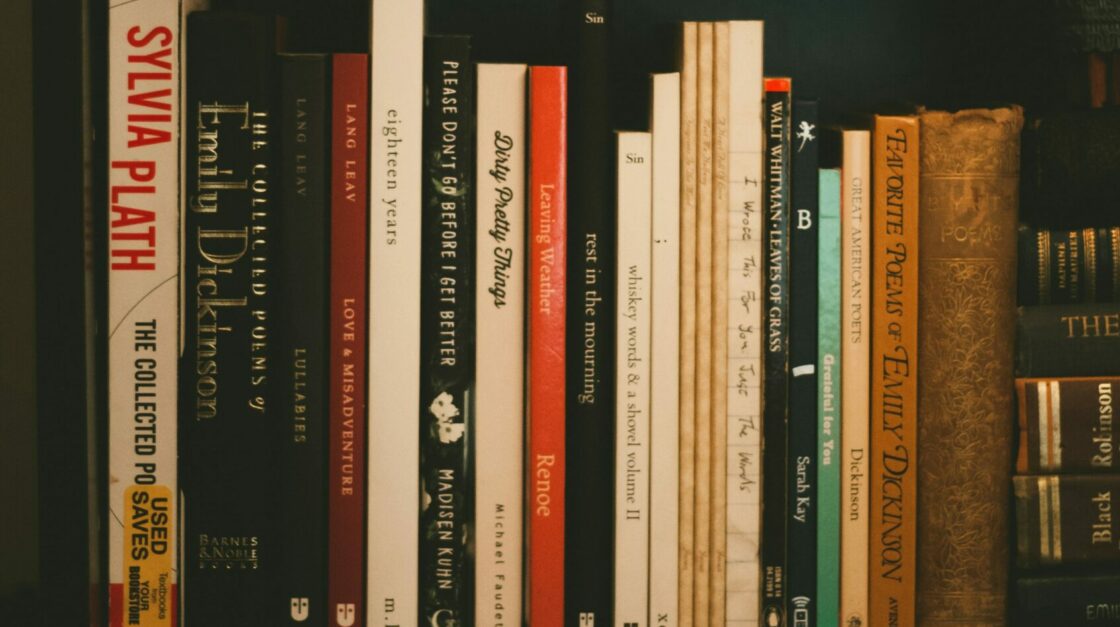
Freewrite
With this freewrite, as well as all freewrites, do not put any pressure on yourself to be good. You are simply getting thoughts on the page. You can write in poetry or in prose, but feel free to write poorly, sloppily, redundantly, and with cliches. Now is the time for ideas—we will eventually sculpt those ideas into art.
What is poetry to you? How do you define poetry? What does it mean for a poem to be a poem?
Freewrite for 8-10 minutes on the nature of poetry itself.
Poem: “Ars Poetica” by Archibald MacLeish
Retrieved from Academy of American Poets.
A poem should be palpable and mute
As a globed fruit,Dumb
As old medallions to the thumb,Silent as the sleeve-worn stone
Of casement ledges where the moss has grown—A poem should be wordless
As the flight of birds.*
A poem should be motionless in time
As the moon climbs,Leaving, as the moon releases
Twig by twig the night-entangled trees,Leaving, as the moon behind the winter leaves,
Memory by memory the mind—A poem should be motionless in time
As the moon climbs.*
A poem should be equal to:
Not true.For all the history of grief
An empty doorway and a maple leaf.For love
The leaning grasses and two lights above the sea—A poem should not mean
But be.
Divinations
This is an ars poetica, or a poem about the art of poetry.
I won’t comment too heavily on the poem itself, because I want you to think through each couplet, which are all different truisms about poetry. Do you agree or disagree? Are these definitions limiting or expansive? How does your relationship to poetry agree with MacLeish’s, and how does it diverge?
And, while we’re here… what is poetry? I think every poet defines this throughout their own body of work. No two poets will have the same definition. Moreover, your definition of poetry will evolve the more you engage with it. This is one of those truths that can alienate people from poetry, because it’s so ineffable and has a bit of a pretentious quality to it, but I want you to think of this as something empowering, not alienating—you get to decide what poetry is and how you relate to it.
So, what is your relationship to poetry? Here are a few additional prompts and questions for you. Maybe even journal about these questions, and see what arises.
- What are some poems that have moved you, shifted your perspective, or moved you deeply?
- Why did those poems move you deeply? Can you point to experiences within the text that did so? Or was it the overall poem that left you in awe? (Both are possible!)
- What do those poems have in common? Think about this laterally. If they have entirely different forms, subject matter, and craft elements, zoom out to make those connections. Maybe each poem changed your view of the world, taught you something about yourself, or surprised you at a lyrical or musical level. But there are plenty of other ways a poem can move you—again, journal about it!
- Think about poems that you’ve written, if you’ve written any. What did you enjoy about the process? What challenged you? Did you feel light afterwards, like something had been untangled in your chest, or perhaps the opposite? How did writing poetry free you? What did it communicate that prose couldn’t?
- Try defining poetry by defining its opposite. Not prose, which is simply a continuation of language’s possibilities, but the opposite of poetry, which is no poetry. What would language be missing if it didn’t have poetry? What would you be missing if you didn’t have poetry?
Ars Poetica Prompt
Write an ars poetica! Write a poem about poetry: what it is, what it means to you, what it can do, what defines its very essence.




Leave a Reply